Translate

Showing posts with label GMing. Show all posts

2017-12-11

Combat for fun and profit


I've talked about how I realized that some old school games were not about killing everything you came across, and how I had never really been a combat heavy GM. So, then why have I run, and plan to run again, Dungeon Fantasy?

First off, I'd like to say there is nothing the prevents me from running a "combat is best avoided" sort of game with GURPS Dungeon Fantasy or the Dungeon Fantasy RPG. But DF (either) does not assume that sort of play. If anything it takes more from video game play, Rouge and Diablo were clearly influences, than the sort of games I use to run. And it clearly states that it is about "killing monsters and taking their stuff", not "avoiding monsters to get to their stuff" or "negotiating with monsters..." and so on.

That said, there are skills and traits that are designed to let characters play that sort of way. The Bard can very much be a "dungeon negotiator". The thief is probably going to be better at sneaking than fighting. Wizards, Martial Artists, and others have several abilities that with some clever use can allow a group to bypass combats.

And DF at it's core is still a game of resource management. And any game that does that, is going to have to have an implied element of choice in combat. What I mean is that if a group is low on Healing Potions, Arrows, FP/ER, etc., then there has to be a choice between risking another fight, or trying to avoid it.

Still, this is one area that I really wish was covered in more detail in G:DF and DFRPG. But it isn't and the game does have a combat focus. A "balanced" combat focus... I really shouldn't like it, but after picking up GURPS DF books 1 and 2 and reading them, I was intrigued.

I don't know exactly what it was, the marriage of my favorite RPG system and the nostalgia for my first, just seeing how well it "emulated" hack and slash, or just because it looked fun. Whatever it was, it drew me in. Even after deciding that I probably wouldn't run a DF game, I couldn't get it out of my mind. I kept coming back. In conversations, online discussions, and other places.

Okay, these guys aren't balanced
Eventually I decided to try out, and ran a "sand box" sort of game using 0one's Caverns of Chaos map, with some of the information from the Caves of Chaos that was distributed with the D&D Next playtest. I found or created a few monster conversions, filled in some treasure, and got ready to play.

But things were hard. I posted several times about my struggles with DF. 250 point characters were on the high end of what I was use to outside of a "supers" game, and figuring out how to balance PCs, enemies, and make it all exciting didn't come naturally to me. After the Caves, the group moved on to the "Castle Von Dark" which was a combination of another published map, and some of my own dungeons. That campaign added more NPC interactions and was a bit more my style.

After a time, I put away DF and moved on to other things. But when I was looking back at my campaigns, I realized that DF was one of the longest running I had ever had. It was "hard" for me as a GM, but over time I was getting better. I was figuring out how to merge my style and the style and assumptions of DF. At times this led to some bad sessions, but I think the good far out weighed the bad.

So, I keep going back to DF. I keep tweaking my approach to it. There are still things I struggle with. Starting combat time before it needs to be, or keeping it going when the action has slowed and it really should be dropped are things I know I need to work on (and will probably write about soon). Dealing with the struggles of Virtual Tables Tops, which can aid some things, but make others more difficult. Adding loot that is rewarding and useful. Creating interesting characters and plots, but letting the players drive the story. Running quicker combats. And yes, even creating "balanced" encounters... and the occasional unbalanced ones. But even with all that, I've had some of the longest campaigns, interesting PCs, and good times running DF.

2017-12-07

Thoughts on "Old School" vs "Modern" RPG Design (Part 2)

...continuing on from last post.

Going back to my first D&D session, after creating my Elf (because elves could have swords and spells), the party spotted some smoke in the distance. I had an elven cloak, so I scouted ahead and saw some bandits burning down a cottage, and a woman tied to chair. The rest of the session was me and the other players discussing what to do. My character had Ventriloquism and my cloak, so I wanted to sneak up, throw my voice and try to convince the bandits I was a ghost in order to scare them off.
 
This ended up taking so long that I had to leave and didn't get to finish out the adventure. Later I learned that the GM had planned that encounter to just be a simple fight. We were "suppose" to go kill the bandits. At the time I laughed about how silly all my advanced planning was, but now I realize something about that game.
 
Again, I did grow up on video games. And most of the times in a video game, you are "suppose" to kill the enemies. But then, there aren't really any other options. But to me table top RPGs weren't "a way to play video games without electricity". They were something MORE. A video game only let you do what it was coded to allow. But an RPG let you do (or at least try) anything. In this way RPGs were always more "real" to me. And I tried to have my PCs act in a way that I thought I would act if I were in this sort of fantastic world. So, I tried to avoid a fight instead of risking injury or death. To do otherwise would have been too... video game-y.
 
This is how I feel about so many modern games and the modern editions of D&D (to be fair, I'd say this had been the trend since AD&D 2nd edition with XP being mainly from killing monsters). Games that balance every encounter so the PCs don't need to think, but can just kill mindlessly. Games where everything scales to PCs capabilities. RPGs that are little more than video games.
 
I use to think that the OSR, was just a bunch of old grognards that were nostalgic for the first set of rules they used. And while that might be part of it, I think there is also some that just reject how the modern game is suppose to be played. (I haven't the foggiest why you need old rules to have an old play style, though.)
 
Anyway, I want to bring this all back to GURPS, because that is the game I love to run. For a LONG time my GMing philosophy for GURPS was, "I don't balance encounters". That is, I would make a Dragon as powerful as... a Dragon! I'd make the King's Elite Guard, well "elite". But then I also didn't really run games that were expecting the players to kill everyone and everything they came across. I use to warn new players how deadly GURPS is, how any fight could be deadly, and that "a fair fight is one you can loose". I wanted players to play smart and only fight if they couldn't find another way. When a fight broke out, I really didn't know who was going to walk away alive.

I'm not really sure where I was going with all this. Just pondering and putting down my thoughts on the subject. If anything it makes me think that I've been GMing "old school" even though I didn't really think of it that way. And while I don't want to beat up on other people's fun, I needed to voice my dislike of games and ways of playing that feel artificial and "gamey" or especially when they are trying to emulate video games, which I still love, but see as a more limited version of the table top experience.

Thoughts on "Old School" vs "Modern" RPG Design (Part 1)

I apologize ahead of time, as this might ramble a bit ... or even turn into a rant....


I was watching a video recently that was listing several of the "iconic" D&D monsters like the Beholder and Gelatinous Cube. What was interesting about this video was the narrator mentioning running away from or avoiding these monsters. This got me thinking about some if the philosophy of "old school" gaming, modern game design, what folks want out of RPGs and many other things.

First, I'd like to say that I in no way claim to be an "old school" gamer. I didn't start table top gaming till the 90's. I think my first exposure to D&D would have been the Saturday morning cartoon, and the AD&D first edition DM guide that one of my older siblings had (but only played once that I recall). I use to thumb through that book looking at all the pictures and imagining games of adventure, but never really got a chance to play till years later.
 
Instead, I grew up on video games. From the Atari 2600, to the NES, to the SNES. And the first "role playing game" I played were JRPG video games like Final Fantasy, Dragon Warrior. There was also a heap of action adventure games like The Legend of Zelda and Faxanadu. My first game of D&D was the "Rules Cyclopedia" basic game, so maybe that's still old school?
 
Anyway, bringing this back to modern day, I find it interesting that the last few editions of D&D, and many other games have had a strong focus on "balance". Every combat encounter is suppose to be "challenging but winnable". Now I for a long time I assumed that GMs that created "deathtrap dungeons" or were out to "win by killing the PCs" were just bad GMs or "doing it wrong."* Maybe this is part of the reason that modern games focus on balance?
 
But what if some of those "killer GMs" weren't really trying to kill the PCs at all? Looking at "old school" adventure modules, it seems like there wasn't really this idea that the PCs should be "clearing the dungeon". Some seem to imply that combat is something to be avoided. And sure the monsters are little more than a collection of combat stats, but those stats paint a dire picture. Maybe GMs were just trying to get players to think about what their characters can do other than be mindless killing machines.
 
The problem is that modern designs seems to focus on letting the PCs be exactly that. If every fight is suppose to be winnable, then there is no need to think if you should avoid the fight, how to trick the monster, or what other options exist. Only a bad GM would put a monster that the party can't defeat in the adventure, right?
 
Maybe this design change came about, not because of bad GMing, but bad playing? There was always "that one player" that did rush in and attack everything. They didn't want to think about tactics, deal with negotiation, and they never backed down or ran away. And maybe there were lots of players that way, and GMs that didn't want TPKs over and over. Those GMs might have "tweaked the numbers", and made that beholder weaker, that dragon slower, and overall let the players win. Because "winning" is what it's all about, right?
 
Or maybe this change was influenced by video game design? More on that later.
 
* I don't want to get into this too much, but I now believe that there is no bad-wrong-fun as long as everyone is on the same page and has the same expectations of the game.

2017-03-15

Rule of Cool

... or "Crazy Plans are More Likely to Work"

A couple of things occurred to me the other day as I was reflecting on my last game session: 1) When players ask lots of questions, the the odds of doing something "cool" decrease. 2) If something sounds cool, it is more likely to work in my games.

I don't really think about these things during the game. They are not rules that I created... but this is just how things work out in play with my games.

Here is an example. In the last session, the party arrived at the cliff that separates the road from the keep. The drawbridge was damaged and only one of the two chains were holding it up. Someone asked if they could see the wench that held the remaining chain, and I replied that it was on top of the keep's wall between the two towers on either side of the bridge/gate. Then someone asked if the wizard flew up there would he be able to release it, and would the bridge land properly across the gap. I said he could probably release it, but that because the bridge was askew and damaged, it might break and fall. They ended up going with another plan.

But, had someone said, "I want to blast the wench with a fireball so the bridge falls and we can cross", I'd probably allow that to work (assuming they made the roll to hit).

Thinking about this, I realized that when I GM, lots of "technical" questions get the simulations part of my brain working. So, the answers I give are likely to be based on what makes the most logical sense for that situation. But, if someone states some crazy plan, the more creative side of my brain gets going and I want that to happen.

Of course the players need information before they can formulate crazy plans, so there's a bit of a catch-22 going on. But I think recognizing the ways that I GM and what some of the factors that lead to it helps me and my players.

2016-02-24

Making Traps Fun

A friend and fellow GM wrote during a chat we were having that he hates traps in RPGs, but that since they were so prevalent that he'd like to find a way to make them more fun. So, here are some of my thoughts are what traps are good for and how to make them fun and interesting in games.

The argument against traps goes something like: Traps if detected are annoyances that have to be dealt with. If they aren't detected they are surprise damage. In both cases they are not very interesting.

Now we could punch holes in the above statements all day long, but what I'd rather do is prevent traps, or players' perception of traps, from resembling it. Here are some of the ways that I try to make traps interesting.


1) Players need to be aware that traps exists. In many games this shouldn't be an issue, but if you haven't been using them, then they suddenly show up, players will be taken off guard. Having a sprung trap near the entrance to your Trapped Halls of Dangerous Traps, with the remains of a less fortunate adventurer nearby, should give the players a good heads up.

2) Traps react to players not the other way around. Traps should trigger off of player actions, and a group that stays still shouldn't find themselves suddenly springing a trap (that's what wandering monsters are for). Conversely, players should know that opening a door, chest, traversing a long hall, etc., could all trigger a traps.

3) The Dungeon/Cave/Wilderness/etc. is an enemy character, and traps are one of the ways that it attacks the players. Traps should fit thematically with that character. Put a bit of thought into types, appearance, and effects of the traps. This will create a sense of consistency and generally be more interesting than just another pit trap.

4) Don't make traps binary! A hidden GM roll followed by damage isn't very fun. GURPS players, especially, are used to having an active role in avoiding damage. So, when traps are triggered, have the players roll a reaction before they are hit. Some examples are: Dodge roll to avoid projectiles, DX rolls to catch a ledge on pits or drop away bridges, or even a series of rolls such as a regular contest to out-run, hold-up, or otherwise struggle against a trap's reaction.

5) Narrate! This is perhaps the most important aspect to making traps interesting. Take the following, Bob heads down the hall, fails to spot the illusion floor, falls, fails to grab the side, then hits the floor hard. This could just be a GM roll to spot the trap, a player roll to grab the ledge, and a damage roll. Or:
GM: <roll> "As you pass down the dark corridor, you step forward and begin to fall. The floor is an Illusion!"  Roll vs DX. 
Player: <roll> Missed by 2. 
GM: "Your arm shoots out reflexively to grab the side, but you just manage to get a handful of loose dirt as you plummet to the darkness below." <rolls damage> "You land hard on at the pit's bottom. Your leg screams in pain and your are bleeding from cuts and scrapes all over. As your eyes adjust you find yourself surrounded by the broken bones of others that were less fortunate than yourself. The calls of your companions from above echo down."

6) Make failure interesting. Aside from colorful narration, have traps cause some sort of change, reveal a clue, or otherwise cause some sort of new information or new action to take place. A trap might fire a dart at the player and cause a hall to shift, doors to seal/unseal. A pit trap might contain treasure or the journal of someone else who had died there.

I could go on, but I think this covers some of the basic ideas that I think can make traps more interesting and fun. I'd also like to mention Pyramid 3/60 for Christopher R. Rice's, "It's a Trap!" which has many great ideas for traps and how to design them.

2015-10-07

GURPS Lost Mine of Phandelver

So, awhile back I decided to run the Lost Mine of Phandelver (the D&D 5th edition starter box adventure) using GURPS Dungeon Fantasy. Why GURPS? I've covered that before. So, I just wanted to go over the general experience of running a 5e adventure with DF.


Since this adventure was for "first level" adventurers, I decided to use the Dungeon Fantasy on the Cheap with a slight modification. I gave the players 150 points for the 100-point templates than told them to ignore the Disadvantages. After they created these characters, they could then buy disadvantages that fit the character and use the extra points to improve other stats. I found taking this approach created characters with fewer and more interesting disadvantages.

Previously I had been a player in a group that ran the LMoP, and what impressed me the most was how much the actual play of the adventure went exactly the same. The first few sessions played out with only minor differences. The "combat balance" felt about the same, and the player dealt with the enemies at the same speed.

The player's choices did diverge quite a bit, especially as the game went on, but the play "felt" the same. In some cases, enemies were defeated much faster than in the 5e game due to GURPS's rules such as major wounds, and -HP.

Here might be a good time to mention that I found converting 5e monsters to GURPS very easy. I had difficulty in the past converting D&D 3.5 monsters, but not this time. I don't know why that was exactly, but it may have had more to do with the lower level of the monsters (and fewer special cases and abilities) than the edition. Still, I found converting Str directly to ST, and the other attributes' modifiers as straight add/subtraction from 10 for the corresponding GURPS stat, to be very quick in converting stats.

Things went very well and the game had some interesting actions by the players (they basically sold the Cragmaw Castle to the Dragon...). But as we neared the end, I knew that the difficulty was about to ramp up.

The adventure seems to have 3 level ranges it deals with: ~1 for the hideout and town, then ~2-3 most everything else, and level 5 for the mine. Even though the players did many of the optional side adventures, and gained a good amount of CP, I had a feeling that the final mine was going to be a bit much for them.

I was almost wrong. The players took the shortest path to the "end" and might have been able to take out the big bad, but after the jelly attacked their goblin pal, and a few bugbears fled into the darkness, they got worried about a flank attack. So, they backtracked to the beginning got a bit worn down by some minor pests, then found themselves in a big dark room filled with ghouls.

Paralytic Attacks = dead PCs.

I treated the paralyzing attack as a stun, and gave the players a HT roll to recover, but the attacks kept coming. The Orc bard held out the longest, but eventually fell.

Overall, the game went very well. While it didn't end "successful", I think it was a success. It played very well and was probably the most fun I had running DF. Maybe in the future I'll revisit some of the published adventures for 5e.

2015-07-01

GURPS Misconceptions: Rules required

A friend of my mentioned that in his D&D 5th ed. game, a player was running from an enemy and wanted to shoot him in the leg to insure his own escape. D&D to my knowledge doesn't have any rules for hit locations, but my friend just ruled on the fly and the game continued. The reason that my friend mentioned this though was because he started to think of all the things that would have been needed to resolve that in GURPS.

That made me start thinking. In other games systems when a situation comes up where there isn't a rule to cover it, the GM rules on the fly using his or her best judgment. But GURPS has rules for just about everything. Because of this, people think that when a situation comes up that those rules cover, then those rules must be used. But the fact is, there is no reason why a GURPS GM can't just rule off the cuff.

GURPS is simple and GURPS is complex. How it plays in individual games is entirely up to the GM. Just because there is a rule to cover a specific situation, that rule doesn't need to be used if GM and players don't want it! Remember "And all the detail is optional – use it only when it makes the game more fun." (Basic Set p.8)

So, if hit locations add too much complexity to your games, don't use them. And if later a player wants to shoot a perusing enemy in the leg, rule on the fly. If you know all the modifiers off the top of your head (-2 or -BULK from Move and Attack, -2 for Leg, and Range penalty), then use that, if you'd need to look it up ... DON'T. Just make it up and keep playing.

I must admit that I've often found myself saying, "I know there is a rule for that" and started searching my books. This is a habit that I am still trying to break myself of. I'm starting to think that having to use an existing rule is almost as bad as forbidding an action when there isn't a rule that covers it. In both cases the GM can just guess at a modifier/target number/whatever, and let the play continue.

Rules should be there to help the GM and players, not get in the way. They should make interacting in the shared imagined world easier and create expected results from character actions. And whether a rule simply doesn't exist to cover a specific situation, or isn't know, or is being ignored, it doesn't matter. The play should be the same: the GM makes a call, the dice are rolled, and the game goes on.

2014-08-11

My struggles with Dungeon Fantasy (part 3)

Over the last couple of weeks I've been struggling with working on my megadungeon. It feels like a chore and I am just not excited about it anymore. While trying to figure out why I was in this funk, I realized that there are many problems contributing. Here is what I've found.

Working Against my GMing Style (again)

I use to be terrified by improvisation. I would create pages and pages of prep notes in my early games because I wanted to make sure that every patron at the tavern had a name, job, etc. But I also hated doing a bunch of work that was "wasted" if the players didn't talk to that NPC, or whatever. After awhile I gave up on trying, and just would roll with the punches. Now I prefer to have just the key details and let the players figure out who's important and who isn't.

My Fallout game had 3 pages of prep (outside of equipment list and templates), mostly of bullet points of a location, the major NPCs there, what those NPCs want, and what they can give. My Traveller game had even less.

It might be that I've gotten lazy, but between work, family, and my other hobbies, I just don't want to spend 3 hours every night working on my weekly game. It ends up causing burn out.

But DF requires a LOT of prep! For DF I need maps, room descriptions, monsters, traps, loot, and other bits of interest. I like making maps, but as I mentioned before this can be hard to do well. DF2 and DFM1 both have some great monsters in them, but most are designed for a very select environment, or are something that is best used sparingly. The same old pit trap gets old quick, so rolling up new ones and making them fit can be a chore. Loot is always a bit strange to me. The simulationist wants to just roll on a table, but the 4th time you get the SM-2 Bows, for your group of Half-Ogre Barbarians you know how unsatisfying that is going to be for everyone.

And so I am burned out. I've thought about just going to published modules, but that means converting monsters, traps, loot, etc. That is a lot LESS work, but also tends to be much harder to make fun and balanced for my group.

While I think that the core problem is that I haven't been focusing enough on "story", and too much on the bits such as monsters and loot, this still is a concern b/c of the time it takes to get this all done.

Possible solutions: Again, I could just go to published modules, but I have a feeling that is going to bore me. I've never been a module guy, so I don't know if that would keep my interest up.

The other idea is to do "dungeon on the fly". I've never tried to do something like this, but have played with how it could be done. The basic idea is to just improve the dungeon, creating a rough map as the players explore, and just throw cool stuff at them randomly. I worry that this is going to create something that make no sense what so ever, and end up going to the silly side of things.

For the most part, I feel this is a problem that diminish with time. The more material I can create the more I can pull from later. So my hope is that once I've sorted out some of the other problems, this will also become less and less of an issue. That is IF I can get myself motivated to keep adding new items every day, and that will take time.

2014-08-07

My struggles with Dungeon Fantasy (part 2)

Over the last couple of weeks I've been struggling with working on my megadungeon. It feels like a chore and I am just not excited about it anymore. While trying to figure out why I was in this funk, I realized that there are many problems contributing. Here is what I've found.

The Megadungeon Misunderstanding

Another big issue that I had was that I wanted to run a megadungeon, but didn't know what one was. I had never GMed, or played in a game with a megadungeon, so my understanding of one was based on what I read (mostly through play reports of others).

I didn't let this bother me because I figured that I could translate my experiences with video games that I thought were Megadungeons, namely the Diablo and Torchlight games. But I was in constant conflict, the ideas didn't seem to stack up correctly. It wasn't until I stared looking more into megadungeon design that I realized that I was just thinking of long or big dungeons, not megadungeons.

Due to this, I've recreated the first floor of my dungeon 4 times. I've redone the side view several times, and I still haven't gotten much done on the first floor in the way of actually detailed and stocked rooms.

I love the idea of a megadungeon, but I'm still struggling on making it work. Part of the reason that I wanted to do one was to have a space that can be "living" and wouldn't require me to draw up a new dungeon every week, but the up front time investment is making it hard to get to the point where I can reuse it. It's also difficult to create large complexes that makes sense, are fun, and provide a variety of options for a group of adventurers.

Possible solutions: Find a copy of Ruins of Undermountain, and convert it? Give up on the megadungeon idea all together?

Honestly, I've already taken parts of Undermountain, and my other "level 1" and merged them together. I now have a dungeon with a central hub area that branches out to other areas. It still needs a lot of work, but it is better fitting with he megadungeon design.

2014-08-06

My struggles with Dungeon Fantasy (part 1)

Over the last couple of weeks I've been struggling with working on my megadungeon. It feels like a chore and I am just not excited about it anymore. While trying to figure out why I was in this funk, I realized that there are many problems contributing. Here are my thoughts and possible solutions.

Working Against my GMing Style

This is sort of the root of all the issues, and I've sort of mentioned this before. I'm use to running games with little prep, and the prep I do being focused on characters in the world. With other games, I start with NPCs and factions, I set up conflict and then let the players take sides and direct the events. This is fun for me, but has at times created lots of in-party conflict as the sides tend to be both morally gray.

Part of the reason I wanted to try DF was to get away from this moral ambiguity, and everything that went with it. I thought I'd just have the players "kill things and take their stuff." So, I didn't bother with a lot of back story, NPCs, or much of anything really. When things started to feel a bit pointless or unfocused, I tried to retrofit in some "quests", but these didn't seem to really strike a cord with the players. That is probably because it didn't really strike a cord with ME.

My time and investment were spent on maps and monsters and loot and the dozens of other things that were fairly new to my GMing style (and initially exciting), and not on the things that keep me interested.

I think this is a case of throwing out the baby with the bathwater. I went overboard in trying to do something different and took away one of the major things that makes me want to GM.

Possible solution: I need to spend more time thinking of the who's who of the setting, creating interesting major NPCs and getting them involved in the PC's lives. This can be problematic in a game where just about anyone is a potential target, but every major NPCs needs to have events that kick off when they are helped, killed, or even ignored.

This sort of thing gets my creative side going. The draw back is that it takes time away from other prep work, and I'm not sure I can run a dungeon w/o monsters, loot, etc.

2014-07-22

Spells as Loot

GURPS Dungeon Fantasy puts some restrictions on what spells casters of various flavors can learn, but doesn't address the issue of spell rarity. When I played D&D (B/X), I recall spells being something that you wanted to find. The spell tomb of a powerful wizard could be a whole quest goal.

While the fighter-types are getting new armor and weapons, the wizard might not need more than a new power item and some potions. Sure, their is lots of cool loot a wizard could get, but that can often pale compared to the astonishing new powers that they gain from spells.

source


For my DF game, I've decided make "higher level" spells more difficult to gain and turning spells into loot. I'm using spells' Magery requirement as the "rarity" level, but with a few other restrictions:
  • Spells that have an unavoidable Magery X requirement in their prerequisite chain inherit that that same requirement.
    • ex. Identify Spell has a prereq of Detect Magic, which requires Magery 1, so Identify Spell is also considered to require Magery 1.
  • Spells with prereq counts greater than 10 are treated like they require Magery 2, Magery 3 for greater than 15.
Otherwise things break down like this:
  • No Magery Req - These spells are widely known and can be studied from books and sources that are readily available (spell instruction books can be found in stores)
  • M1 - These spells are commonly taught at the Wizards' Guild (standard training fees).
  • M2 - These spells are somewhat restricted. The Wizards' Guild may require that the player perform some service or at least be in good standing (no crimes against) the guild. These tend to cost more (1.5x) for training.
  • M3 - These spells are often unknown, hidden, forbidden, or otherwise not taught. Players will have to find a lost spell tome, hidden trainer, etc., in order to learn this spell.
For starting characters I'm thinking of limiting starting spells to: Any number of spells with no magery req, Magery x 3 M1 spells, Magery x 1 of M2 spells, and M3 are off limits.

Clerics and Druids are also limited, but using the PI requirements in DF1. I'll just map PI6 = M3, PI5 = M2, PI4  M1; PI3 or less as No req. Cleric spells aren't usually found, but instead are gained via donation to the church (training cost) and prayer. A god can give a spell to a character who has performed some service. Druid spells can be found, but are more likely to require a master Druid who lives in some remote place.

2014-06-13

You can do it!

I love being the GM. Playing is fun, but I would prefer to GM over playing most of the time. There are a lot of reasons for this, but it mostly boils down to a desire to entertain. But that is just me. I understand that there are (probably a lot more) folks who prefer to play. Sometimes, though, that isn't an option.

Recently, I've seen (especially in the VTT circles) many folks who want to play, even some that "have a great idea for a game", but also say, "I don't GM". I've even see some folks who seem angry that the GMs of these communities are not running their favorite game!

This kind of thinking floors me! If you like game X, and nobody is running/playing it... then why don't YOU GM! Maybe you prefer to play, but when that isn't an option, you need to do some work.

To get others to GM your game, the first step is to get people interested in it. You can talk up a game system till the sky falls, but there are not a lot of folks that are going to pick up a new game to start GMing based on that alone. The best way to get folks involved is to run it for them. Show it, demo it, run it. You can't expect the world to simply conform to your desire with no effort on your part!

Maybe you feel that you wouldn't be a great GM? I felt this way often. But trust me, if you are making an effort to entertain others, they typically will be forgiving and even help you out. There are lots of great blogs, books, pod-casts, etc., that are dedicated to giving advice to GM's new and old.

So, give it a shot! Who knows, you may get others excited to run your favorite game!

2014-06-09

Dungeon Fantasy Rules Issues

Recently I had to reevaluate a few of the rules I had been using in my DF game that were causing some problems and ended up needing to be "nerfed".

Luck House Rule

For some time I have been using a house rule for Luck. Each "level" of luck gave the player 3 "Luck Points" to redeem whenever they wanted. I did this because I really didn't want to have to keep track of real world time for a game mechanic.

The problem came when a character had Extraordinary Luck, and thus six Luck Points. These were simply too powerful, especially combined with a very high skill character. He only needed to use the point on the rare critical failure, or extreme situation.

I spend some time trying to figure out how to fix this house rule, but ultimately decided to just scrap it and go back to the RAW.

More Than Two Hits with Rapid Strike

This is not a rule that I normally used, but I figured that this was over the top heroic fantasy, so why not? Well, because it really makes short work of just about monster, especially after a few points are spent to bring up ST.

I felt that this was fine for awhile, but after my last game where my other players were mostly marginalized by the the high skill character performing 4 rapid strikes (on top of an extra attack) I've decided to cut this and go back to just 2 hits for rapid strike.

---

These two rules were overpowered on their own. Combined they compounded and created a way over powered character. I hate to "nerf" a character after rules have been decided, but if the rules are causing it much harder to make a balanced game where all the PCs feel they can contribute and feel useful, then things have to change.

As always, I consider GMing an evolutionary process where I learn from each experience and adjust to make an even better game.

2014-06-03

My New Dungeon Tool: Google Spreadsheets

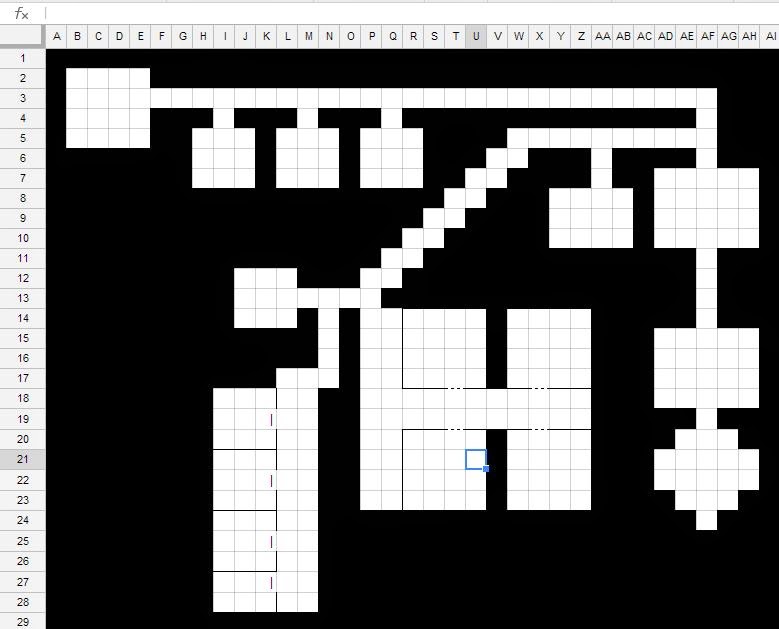
I've been struggling with how to create dungeons that can: 1) be easy to use, 2) easy to upload to a virtual table top, 3) works with my limited time/space/skill. Jotting down dungeons on graph paper is nice, but doesn't scan very well. Drawing them up in paint can be more of an effort than is worth while. The various software packages that are based on dungeon design tend to have cumbersome UI, and don't always let me export the way I want.

So, I started using Google Spreadsheets. I'm already a big fan of Google Drive and use it for sharing and storing game materials.

Here's how I do it:

First I do still tend to jot down a quick sketch of the dungeon. Just a few square rooms and labels. This gives me a good idea of how I want rooms to relate to each other and what the general purpose of the space is used for.

Then I create a sheet of 35 columns and 42 rows, and resize them to 20x20 pixels.


Now, I like to use "subtractive" design. I find this faster than additive and filling in the null spaces. Your millage may vary. To do this I fill the whole sheet using the Fill Color. I choose black, but dark grey also works (or any other color, you like).

Once this is done, I'll start to carve out rooms by selecting the area and changing the the fill color back to white. Tip: once you have one white space, you can copy/paste. I tend to copy one cell and just select areas to paste into. (Again, this is subtractive design. If you prefer, you can just start to fill in the walls instead of filling the whole space then placing rooms back in.)


Now I use both 5x5 and 10x10 feet maps, depending on what I need. Let's say that this is a 10 foot grid map. Sometimes I don't want to have 10 foot walls, so I use the Grid boarders to create small wall lines. I'll fill in some of the large rooms to make them into sets of smaller rooms.

I might find that I need to add some other walls or halls also to make sure things are working as I designed. For doors I sometimes use the vertical bar, backslash, forward slash, or other characters. For bars I tend to use the broken boarder line.


Then I just need to add any other features. Sometimes I just add a lowercase letter then add a dungeon legend somewhere. I use a filled block with a '$' in it (in white) to show hidden doors. If a room has to have a label, I can also just place that in by merging cells. I use bold U and D for stairs.


And there you have it. I use an image printer to print out the sheet to an image file that I can then upload to a VTT. Remember to hide grid lines when you print!

Another map I made.


2014-05-31

Mr. X

I use to try and stat up all the NPCs for the games I ran, and quickly found that this was a huge waste of time. Most of the NPCs that the players interacted with didn't need detailed stats, and many of the "random" folks that they met along the way did.

I developed a few generic templates that I could use for guards, merchants, bandits, etc. but even this was cumbersome to port from one genre to the next.

So, now when I need an NPC on the fly, I just stat it up as Mr. (or Ms.) X, where X is the highest level attributes they have. They might have all attributes at X, or have 2 at the X level, 1 at X -2, and 1 at 10 (Unless needed stats rarely go under 10 for these generic characters). I then just decide that any skill that is part of the primary focus for that character is at Attribute+2.

Sometimes I give the character all 12s

Here is an example:

Mr. 10: All stats 10, skills 12

Mr. 12: All stats 12, skills 14

Mr. 14 (combat): ST 14, DX 14, IQ 10, HT 12, Broadsword 16

And so on...

A table with basic damage and listing the common weapons and armor of the setting is the last bit if these are going to be primary combat types.


2014-05-29

Does Dungeon Fantasy Need Story?


"There is a hole in the ground, you've heard it's full of treasure!" For many, this is as much story as you need for a DF game. But for me, I need a be more to keep me from becoming board with the game. That goes for GMing as well as being a player.

While running the "Caverns of Chaos", I found that the only reason the players would need to go to the caves was for another payday. Sure they were helping the town, but the direct effect was getting loot! And while players like loot, the motive felt weak. Some of the he players wanted more of a reason to keep returning.

My initial solution was to create a few "quests" from towns folks who needed item X or to rescue person Y. These worked okay but became "this week's justification." Then, I created a longer quest for the players to find and destroy an evil alter.

The quests worked out fine, but looking back I think what was really needed wasn't a reason to go to the caverns, but a desire to. Perhaps if I had put more work into strange and interesting things that were there, the players wouldn't have needed a particularly strong external reason to return week after week.

What I am saying, is that Dungeon Fantasy does need story, but that the best story should be environmental. The PLACE should be the story. Strange rooms, new creatures, odd happenings, lost history, etc.

Going forward I still will have a "meta-quest" to drive the players into the dungeon, but once there, I think the real story is going to be what they find and discover. Exploration is story.

2014-05-23

Making Disadvantages Fun


I've always thought that Disadvantages define more about a character than anything else on the characters sheet. Sure, Skills and Advantages tell what a character can do, but Disadvantages tell who they are.

So, I like Disadvantages when they are selected to flesh out a character, to play into a characters concept or back story. I also hate when they are used just to pick up points. Honestly, I wish that official templates didn't include Disadvantages at all, and instead just listed some "Common Disadvantages" in the customization notes. (I also have a bit of a pet peeve how GCA requires picking the exact value of Disads from the Template...).

When done right, disads can add a lot to a character, but at the same time they can be very disruptive to the group as a whole. Things like Obsession, Vow, and many Compulsive Behaviors can lead to character in conflict with the party's goals. Of course the basic social contract comes into play here: don't be an ass. RPGs are a group entertainment activity, and should be fun for everyone involved.

To that end, I have a few tips and some advice on how some disadvantages might play out in a game (with a leaning toward DF here).

First off, disadvantages are a great way to get a bit of "spotlight time" for your character, but this can be a tricky road. The game isn't about your character, it is about the group. Try to keep this in mind. If you really want to play an Obsessed, Jealous, Loner, you'd be better off playing a one-on-one game (or go write a book).

Also, when RPing something that could potently be detrimental to the rest of the party (and most things that are bad for your character are bad for the group), try to make it entertaining! It is easier to forgive something that hurts the group if it was fun to watch or be a part of.

Now, here are some disads that have come up in my games (most are on DF templates) and how I see them as being used in a fun way:

Absent-Mindedness: "You have trouble focusing on anything not of immediate interest." This comes into play whenever there someone else is performing a task that takes longer that a few seconds. The character might wonder down a passage while a lock is being picked, start to practice skills while a room is searched.

Again, make this fun and entertaining, but also don't try to steal the spotlight. Absent-Minded is more about not being involved/aware. A quick, "I've wondered down the left path." When things slow down, or right before they pick up, might be enough.

Charitable: "acutely aware of others’ emotions, and feel compelled to help" This is the bleeding heart disadvantage, and should be played up that way. Charitable and other "compulsion" disadvantages shouldn't only mean that you have to do that activity, but that you feel the need to! Play that up!

Code of Honor (Gentleman’s): NEVER break your word, ignore an insult, or take advantage of an opponent. While this states that it only applies between gentlemen, I think that is just seeking recompense, you would still punish "non-gentlemen" such as, "Discourtesy from anyone of Status 0 or less calls for a whipping, not a duel!" There are few gentlemen in the dungeon, but the any sentient being should be treated with some respect, and you should expect some respect in return, or act accordingly.

Curious: This is major curiosity, not just "hm, what's in that dungeon", but "hm, what happens when I press this button marked, 'Never Press'?" This can be easily the most entertaining disadvantage a character has... but is best paired with some resilience to damage.

Obsession: This can be a real problem in a group. If the obsession ties directly into the groups focus, this could work, but may also require in-party arguments or persuasion to convince the character that deviation from the obsession will still lead towards the overall goal. This can be very fun if the other players are willing to have these debates (and they win sometimes). Otherwise avoid this.

Overconfidence: This is probably the most commonly taken disadvantage I've had in my groups, but in some ways the hardest to pull off. The idea is that you think you are FAR more capable than what your character sheet has. Treat all your skills as if they were 6+ points higher! If you don't have Luck, act as if you do! If you do have Luck, act as though you don't need it!

The goal is to have fun as a group, and have an interesting character. These don't have to be in conflict. The group should work together to make sure that the characters are all compatible and okay with each other. Characters with disadvantages that come in conflict with others can be fun, but only when it doesn't lead to deadlock. Figure out what works, change what doesn't, and 

2014-05-22

My Worst GMing Mistakes

To err is human... even when you are the GM. I have had my fair share of GMing fumbles over the years, here are a few and what I've learned since then.

Plot Without Players

I don't think I was ever a "rail-road" GM. If the players wandered off, I might throw the plot at them in the next town, but I never "forced" the plot.

What I did start doing was having the plot progress without the player involvement at all. I had a timeline of events that were going to happen if the PCs got involved or not. The problem with this is that all the prep and investment on my end were wasted, and the player were never quite sure why things kept happening off screen, or why things they clearly had no interest in were the focus of the game. Basically, the PCs were not the principle characters in the story, and that was not as fun as when they are.

Now, I still create strong NPCs, and they have plans. I might even set up events to trigger their next move (if the prince is killed, we declare war...), but the story is about what the players are doing. If they don't get involved, then these NPCs and their plans can go to the way side. I also try to get the players interest or party goals to be what intersects with the NPC plans.

The Michael Bay Effect

I use to have a list of GMing "tips" that I kept at the top of my GM screen, or with my game prep notes, and the first item was something like "if nothing exciting is happening, change that!" So, when I would run games at the first sign of the party floundering or things slowing down, I would have something blow up, or some crazy NPC show up screaming, or something just plain weird happen. And the next, I'd have a bigger explosion, crazier NPCs, or even more strange things.

What this led to is games racing into the "silly zone." Every scene was more over the top than the last. Plots were abandoned and the players pursued or fled from whatever new crazy thing had shown up. Sure, this was fun... for awhile, but games like this tended to burn out fast.

I still try to keep on top of when my games slow down, but now I try to keep the action a little more even. I will jot down a few ideas for "random encounters" that I can plop down, but try to make sure they bring something to the game that ties into what major NPCs are up to, or give some details of the world. I'll still throw in some crazy stuff happening, but also allow for some mild lulls. Sometimes players need a breather.

That's Not Clever Enough

Uh... this is the worst one. To put it simply, when the PCs came up with what they though was a clever plan, but I felt it wouldn't work... it didn't.

One specific example that I recall is when the players needed to "out wit" a powerful (and incredibly intelligent) wizard in a fairy-tale type game. One of the characters had "No Sense of Humor", so they devised a plan to have a battle of "wit" be a humor battle. The first person to laugh would loose. At the time, I just didn't feel this master wizard would go for this plan.

Thinking back on it, I should have allowed it. I want to encourage the players thinking outside of the normal RPG tropes, and handling things in unique ways. This was actually a good plan... and so it should have worked, or at least had the opportunity to be tested.


Well that is just some of the mistakes I've made over the years, and I am sure to make new ones. My goal isn't to be a perfect GM, just a better one each time.


2014-05-20

If you stick your hand in a dragon's mouth...

Yes, most of this doesn't apply in a Dungeon Fantasy game, which I am currently running. Still, I felt the need to write this as it is something that has bothered me for awhile, and a recent podcast sort of cemented the idea in my head.

I often hear about GMs who care more about the story they want to tell than the story that comes from the PCs actions. The typical reaction to this is that those GMs ought to just write a book, since they want to control every aspect of the story anyway. I totally agree with that assessment, but want to talk a bit about the other side of the story: the player that wants to control ever aspect of their character's story.

Maybe, I am opening up myself for a lot of flak here, but I feel that some players need to learn to just let go of their big plans for these darling little PCs. If they want to be in control of ever aspect of that characters story, then they should go write a book!

I understand that players' level of control within a game is limited to just what their character is (via character creation) and what they do (during play). In some games players have more narrative control and that is fine, too. I'm also not talking about stuff that the PC had no control/choice over at all, such as a PC waking up with a bite on their neck and now they are a vampire.

What I take issue with is a rejection of what can happen to the character in play. Sure, the GM and players should probably decided before the game on things like: how common is death, can it be reversed, how crippling is combat, etc. But sometimes, players simply don't want anything interesting to happen to their character unless they planned for it. 

The PCs take risks, but only wanting the reward not the consequences. I'll take a silly example of a dragon that ask the player to stick his hand in its mouth (maybe he has something suck in his teeth). Now the player should know that there is a risk that the dragon might close his mouth, chomping off the character's hand (if not, that player should buy Common Sense for his characters from now on). Now when that eventually happens, what should be the next step (after killing the dragon that is)?

For some players the solution is to either (1) fast forward time to the point where the character can have the hand magically restored, or (2) retire the character. After all, if they wanted a one-handed character, they would have taken the One Hand disadvantage at character creation, right? But these are are just ways to not have to deal with something the player had not intended for the character.

In GURPS there are all sorts of ways that characters can gain new disadvantages. Fights can end with crippled limbs, fright checks can result in new quirks or even new disadvantages, getting caught trying to con the king is likely to gain a new enemy. And so on.

The argument is, of course, that it isn't fun to deal with this sort of limitation. My counter is: it can be.

First, it is a great opportunity to role-play. What is character growth if not struggling to deal with something new and unexpected? How do the adapt to this? How do the overcome it? How do others react? As both a GM and a player, I like to be surprised by things. Characters often evolve into something totally new based on the experiences they have, so when I play, I want to role-play out the aftermath.

Second, it is not the end of the world... most of the time. Yes, there are cases where the game as is can't really go on. A warrior who lost the use of both his arms is likely to need to retire or become a non-adventuring PC. But how often does that sort of thing happen (other than flat out death)? Lose a hand, you can fight with your other, and get a hook. Loose an eye, you can still see. Loose a leg, get a peg. Let's face it, pirates are cool! Seriously, the adventuring life can continue.

Third, this is a great chance for new adventures, and can often allow a PC to take center stage in the game without the other players taking issue. Sure, it would make me mad to play in a game that was focused on one characters obsession to destroy all the kingdom's cabbages, but if a fellow adventurer had been cursed to violently attack every cabbage on sight, and we had to quest to the lost crypt of Sa-lad to end the curse, I'd be there! Silly examples aside, this is one of the times when it is okay to so a bit of spotlight hogging while dealing with this issue.

I have some other points, but I think my argument has been made. If you want to control your character's fate, go write a story. But, if you want a chance to be surprised, to see actual character growth, and to have a chance to play out a story that might be much better than anything you or your GM would have come up with... let the dice land where they may, and take the good with the bad.

2014-05-16

How I've Maintained a Weekly Game

I've been gaming since the early 90's, and I've always wanted to play/run more than I was. Even back in my high-school and college days, it seemed that I never got to play on a regular basis. Now, even though I am working full time, have a wife, two kids, and the million other things that go into modern life, I am gaming more than ever!

I run a game online with 5 players across 3 time zones on a weekly basis, and have been running (or playing) in these games since March 14th of 2013. In that time we've only missed 6 weeks! Even before that I was doing fairly good in 2012 with a weekly game.

One of the reason for this is that we game on-line. While there are plenty of drawbacks to online gaming and VTTs, they also remove issues of location, travel, etc. The game is always at the same place... at our computer desks. No traffic, no dealing with the need to host, none of that. Just sit and log in.

And it is almost always on the same day at the same time: Thursday's 8:30 pm (eastern). With few exceptions, we have kept to that day and time for over a year. This makes it easy for everyone to plan around the game night and try as best as we can to keep that night free. Making it a week-day and not a week-end also means fewer things "come up" out of the blue to mess with the schedule.

I have to give props to our group at being pretty dedicated and doing what they can to free up this night for our games. It isn't perfect, but everyone had done what they can and it has been working.

The last thing is that while we try to keep everything stable, we are also flexible with folks coming in late, or needing to cut out early. It is better to have a game where someone can't make it or where someone left early, than to not have the game at all. Things keep moving, the story advances, and interest in the game grows. This helps me (and I hope the others) stay motivated to keep playing and having fun.

A few other things that have helped are: Google+, I created a Group where we can post game related information or questions. All our games are scheduled using the Events system, and we run the games using Google Hangouts (with Roll20). Roll20 is another thing that has help a lot. It is hands down the best VTT I've ever used!