Today's Daily Illuminator has the top 10 products from March. Four of which are GURPS products. I'm a little sad that not one got a shout out in the blurb, but it is still nice to see this list.
http://www.sjgames.com/ill/archive/2016-04-22
2016-04-22

2016-03-09
Shared Doc for Online Game Character Sheets
I game almost exclusively online. This creates a whole new set of problems than playing face to face, but there are some advantages.
One issue I had thought was making sure that my players and I were looking at the same thing when it comes to character sheets. We were using a character creation program, and my players would often load the program and use it as the character sheet. We even had the save files stored on a shared cloud based service, but there would still be issues with desync. And my UI might not match their's. So, I started looking for a better solution and found it with Google Docs.
There are several character sheet templates out there, and I have to admit that mine is mostly based on a couple of really good ones, but I made this one to fit my group's needs.

The advantage of using a Google docs and sheets is that we can see edits, make notes everything updates right then. It has eliminated the issues I had before.
Take a look and feel free to copy, clone, whatever. There are quite a few calculated fields, so take care not to edit a cell till you're certain that it isn't a formula. (one of these days I may make an instructions page for this).
One issue I had thought was making sure that my players and I were looking at the same thing when it comes to character sheets. We were using a character creation program, and my players would often load the program and use it as the character sheet. We even had the save files stored on a shared cloud based service, but there would still be issues with desync. And my UI might not match their's. So, I started looking for a better solution and found it with Google Docs.
There are several character sheet templates out there, and I have to admit that mine is mostly based on a couple of really good ones, but I made this one to fit my group's needs.
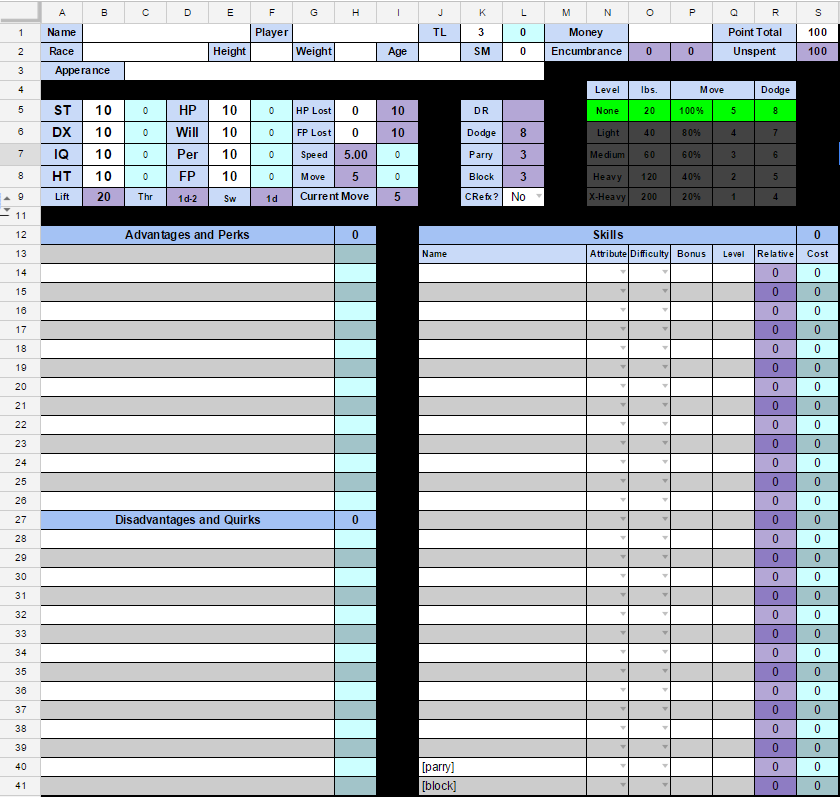
The advantage of using a Google docs and sheets is that we can see edits, make notes everything updates right then. It has eliminated the issues I had before.
Take a look and feel free to copy, clone, whatever. There are quite a few calculated fields, so take care not to edit a cell till you're certain that it isn't a formula. (one of these days I may make an instructions page for this).
2016-02-24
Making Traps Fun
A friend and fellow GM wrote during a chat we were having that he hates traps in RPGs, but that since they were so prevalent that he'd like to find a way to make them more fun. So, here are some of my thoughts are what traps are good for and how to make them fun and interesting in games.
The argument against traps goes something like: Traps if detected are annoyances that have to be dealt with. If they aren't detected they are surprise damage. In both cases they are not very interesting.
Now we could punch holes in the above statements all day long, but what I'd rather do is prevent traps, or players' perception of traps, from resembling it. Here are some of the ways that I try to make traps interesting.

1) Players need to be aware that traps exists. In many games this shouldn't be an issue, but if you haven't been using them, then they suddenly show up, players will be taken off guard. Having a sprung trap near the entrance to your Trapped Halls of Dangerous Traps, with the remains of a less fortunate adventurer nearby, should give the players a good heads up.
2) Traps react to players not the other way around. Traps should trigger off of player actions, and a group that stays still shouldn't find themselves suddenly springing a trap (that's what wandering monsters are for). Conversely, players should know that opening a door, chest, traversing a long hall, etc., could all trigger a traps.
3) The Dungeon/Cave/Wilderness/etc. is an enemy character, and traps are one of the ways that it attacks the players. Traps should fit thematically with that character. Put a bit of thought into types, appearance, and effects of the traps. This will create a sense of consistency and generally be more interesting than just another pit trap.
4) Don't make traps binary! A hidden GM roll followed by damage isn't very fun. GURPS players, especially, are used to having an active role in avoiding damage. So, when traps are triggered, have the players roll a reaction before they are hit. Some examples are: Dodge roll to avoid projectiles, DX rolls to catch a ledge on pits or drop away bridges, or even a series of rolls such as a regular contest to out-run, hold-up, or otherwise struggle against a trap's reaction.
5) Narrate! This is perhaps the most important aspect to making traps interesting. Take the following, Bob heads down the hall, fails to spot the illusion floor, falls, fails to grab the side, then hits the floor hard. This could just be a GM roll to spot the trap, a player roll to grab the ledge, and a damage roll. Or:
6) Make failure interesting. Aside from colorful narration, have traps cause some sort of change, reveal a clue, or otherwise cause some sort of new information or new action to take place. A trap might fire a dart at the player and cause a hall to shift, doors to seal/unseal. A pit trap might contain treasure or the journal of someone else who had died there.
The argument against traps goes something like: Traps if detected are annoyances that have to be dealt with. If they aren't detected they are surprise damage. In both cases they are not very interesting.
Now we could punch holes in the above statements all day long, but what I'd rather do is prevent traps, or players' perception of traps, from resembling it. Here are some of the ways that I try to make traps interesting.

1) Players need to be aware that traps exists. In many games this shouldn't be an issue, but if you haven't been using them, then they suddenly show up, players will be taken off guard. Having a sprung trap near the entrance to your Trapped Halls of Dangerous Traps, with the remains of a less fortunate adventurer nearby, should give the players a good heads up.
2) Traps react to players not the other way around. Traps should trigger off of player actions, and a group that stays still shouldn't find themselves suddenly springing a trap (that's what wandering monsters are for). Conversely, players should know that opening a door, chest, traversing a long hall, etc., could all trigger a traps.
3) The Dungeon/Cave/Wilderness/etc. is an enemy character, and traps are one of the ways that it attacks the players. Traps should fit thematically with that character. Put a bit of thought into types, appearance, and effects of the traps. This will create a sense of consistency and generally be more interesting than just another pit trap.
4) Don't make traps binary! A hidden GM roll followed by damage isn't very fun. GURPS players, especially, are used to having an active role in avoiding damage. So, when traps are triggered, have the players roll a reaction before they are hit. Some examples are: Dodge roll to avoid projectiles, DX rolls to catch a ledge on pits or drop away bridges, or even a series of rolls such as a regular contest to out-run, hold-up, or otherwise struggle against a trap's reaction.
5) Narrate! This is perhaps the most important aspect to making traps interesting. Take the following, Bob heads down the hall, fails to spot the illusion floor, falls, fails to grab the side, then hits the floor hard. This could just be a GM roll to spot the trap, a player roll to grab the ledge, and a damage roll. Or:
GM: <roll> "As you pass down the dark corridor, you step forward and begin to fall. The floor is an Illusion!" Roll vs DX.
Player: <roll> Missed by 2.
GM: "Your arm shoots out reflexively to grab the side, but you just manage to get a handful of loose dirt as you plummet to the darkness below." <rolls damage> "You land hard on at the pit's bottom. Your leg screams in pain and your are bleeding from cuts and scrapes all over. As your eyes adjust you find yourself surrounded by the broken bones of others that were less fortunate than yourself. The calls of your companions from above echo down."
6) Make failure interesting. Aside from colorful narration, have traps cause some sort of change, reveal a clue, or otherwise cause some sort of new information or new action to take place. A trap might fire a dart at the player and cause a hall to shift, doors to seal/unseal. A pit trap might contain treasure or the journal of someone else who had died there.
I could go on, but I think this covers some of the basic ideas that I think can make traps more interesting and fun. I'd also like to mention Pyramid 3/60 for Christopher R. Rice's, "It's a Trap!" which has many great ideas for traps and how to design them.
2016-01-01
2015 Gaming Review
2015 was an odd year for me. "Unstable" is probably the best way to describe it. And that goes for my gaming as well.
The beginning of the year saw a false start on a Technomancer game. This was a case where working on the world and templates was more fun than figuring out what exactly is going to happen in each session.
And after the false starts we had at the end of 2014, I decided to go back to something that had worked really well previously: Dungeon Fantasy.
This time around I went with a "kitchen sink" approch to DF. Just about anything was allowed in the setting. Instead of getting a party of totally mismatched crazy characters though, everyone wanted to play Arakuns (my Racoon-men race). This game when on for five sessions then sort of came to and ending point.
The big story arc was somewhat resolved, and I wasn't sure where to go with the game. Again this was reflecting the general chaos in my life. So, we started another new DF game.
Since my own creative process kept stalling on me, I decided to go with a ready-to-serve solution. I ran the Lost Mine of Phandelver using GURPS Dungeon Fantasy (for those that don't know. LMoP is the adventure packed in the D&D 5th edition starter box).
The game went very well and things started to get back to a more consistent format. The Players made many interesting choices so as a GM I was kept very entertained. The most challenging part was converting the D&D monsters to GURPS. I used a few simple rules for conversion, But the special abilities of some monsters are still geared for D&D and I knew that any session could be the last.
Well the session I expected to be the last was... but not for the reasons I thought. The party were practically right outside the "big bad's" room, when they decided to circle back around. Some enemies had fled, and they didn't know what the rest of the dungeon looked like. This cost the characters' lives.
They got ambushed by a bunch of ghouls with paralytic attacks. This was bad enough, but they also never seemed to get the upper hand in battle. Some bad dice rolls, some turns spend on positioning that didn't really help, and a few other factors led to the death of the PCs.
TPKs are never good, but I still felt that this was a good campaign. It lasted a good while, and was a lot of fun. ( 10/10 would TPK again! )
There was another false start with an Infinite Worlds game. Then we went back to another familiar setting: Fallout.
I've run 8 sessions of Fallout so far, and it has been fun. We're running through the events of the first game, but I think things might take a left turn from that soon.
So, here is to another year of gaming!
A note on the blog: updates have been few lately. This is due to a lack of time and because I am not pondering on rules as much (my Fallout game is not using tactical combat). Still, I plan to post more this year.
2015-11-04
GURPS in Fallout, or Fallout in GURPS
When I decided to run another Fallout game, I wasn't sure if I wanted to use GURPS, Fudge, or the Fallout PnP game. I eventually decided to go with GURPS because I'm most familiar with it, and I felt that the "grittiness" of the system mixed well with Fallout.
There are some really great resources that others have put together for a GURPS Fallout game, and while looking through many of these I noticed there were a lot of folks trying to emulate the "perks" and other traits from the games in GURPS.
At first I was caught up with this idea, and started looking at what perks I wanted to bring over as meta-traits for my game. But after awhile, I started to feel that this idea was a bit silly.
Video games have been trying to emulate the table top for a long time. The original Fallout game was going to use GURPS, before the SPECIAL system, and even that has a lot of similarities still to GURPS. The Perks and Traits from Fallout are just takes on Advantages and other traits that can be taken in GURPS. They are far more restricted and limited though, as you'd expect in a video game.
So, why are we not trying to emulate in a table top RPG a system that was designed to emulate table top RPGs? This is chasing our tails!
I had to ask myself, do I want to use GURPS to play Fallout, or play GURPS in the Fallout setting? GURPS allows both, but in the end, I'd rather just use the setting and not worry about a set list of meta-traits.
2015-10-14
GURPS Fallout Character Survey
For our next game we decided to play Fallout. Instead of the typical character creation session, I decided to give the players a "Character Interview" and then build the characters myself based on their results.
While I'm not 100% pleased with the final survey, it worked well enough for us to build characters. In the future I may revisit this survey and expand on it. Most of the questions come straight out of Basic Set, so I don't take full credit for this.
Below is the basic form, but I used Google Drive to host the form and record the responses. That can be seen HERE.
Gender:
Age:
Strength (1-10)
Perception (1-10)
Endurance (1-10)
Charisma (1-10)
Intelligence (1-10)
Agility (1-10)
Luck (1-10)
Alive?
Father's Job Assignment:
Mother's Name:
Alive?
Mother's Job Assignment:
Describe your relationship with your parents.
Do you have any self-taught skills?
What is your current job assignment?
What other job assignments have you held?
If you can name and describe other vault dwellers you could call friends:
Enemies:
If you can name and describe other vault dwellers you could call enemies:
Close Professional Associates::
If you can name and describe other vault dwellers who are your close professional associates:
How would you describe your own code of morality?
What are you deep held beliefs?
Likes:
Dislikes:
Hobbies:
Other Interests:
What motivates you the most?
What are your plans for your life in the vault?
While I'm not 100% pleased with the final survey, it worked well enough for us to build characters. In the future I may revisit this survey and expand on it. Most of the questions come straight out of Basic Set, so I don't take full credit for this.
Below is the basic form, but I used Google Drive to host the form and record the responses. That can be seen HERE.
Generalized Utility Record and Personal Summery
Basic Information
Name:Gender:
Age:
SPECIAL
How would your rate yourself? (Total should be around 40)Strength (1-10)
Perception (1-10)
Endurance (1-10)
Charisma (1-10)
Intelligence (1-10)
Agility (1-10)
Luck (1-10)
Family
Father's Name:Alive?
Father's Job Assignment:
Mother's Name:
Alive?
Mother's Job Assignment:
Describe your relationship with your parents.
Assignment History
What training have you received?Do you have any self-taught skills?
What is your current job assignment?
What other job assignments have you held?
Relationships
Friends:If you can name and describe other vault dwellers you could call friends:
Enemies:
If you can name and describe other vault dwellers you could call enemies:
Close Professional Associates::
If you can name and describe other vault dwellers who are your close professional associates:
Background and Interests
What were the most important moments of your life?How would you describe your own code of morality?
What are you deep held beliefs?
Likes:
Dislikes:
Hobbies:
Other Interests:
What motivates you the most?
What are your plans for your life in the vault?
2015-10-07
GURPS Lost Mine of Phandelver
So, awhile back I decided to run the Lost Mine of Phandelver (the D&D 5th edition starter box adventure) using GURPS Dungeon Fantasy. Why GURPS? I've covered that before. So, I just wanted to go over the general experience of running a 5e adventure with DF.

Since this adventure was for "first level" adventurers, I decided to use the Dungeon Fantasy on the Cheap with a slight modification. I gave the players 150 points for the 100-point templates than told them to ignore the Disadvantages. After they created these characters, they could then buy disadvantages that fit the character and use the extra points to improve other stats. I found taking this approach created characters with fewer and more interesting disadvantages.
Previously I had been a player in a group that ran the LMoP, and what impressed me the most was how much the actual play of the adventure went exactly the same. The first few sessions played out with only minor differences. The "combat balance" felt about the same, and the player dealt with the enemies at the same speed.
The player's choices did diverge quite a bit, especially as the game went on, but the play "felt" the same. In some cases, enemies were defeated much faster than in the 5e game due to GURPS's rules such as major wounds, and -HP.
Here might be a good time to mention that I found converting 5e monsters to GURPS very easy. I had difficulty in the past converting D&D 3.5 monsters, but not this time. I don't know why that was exactly, but it may have had more to do with the lower level of the monsters (and fewer special cases and abilities) than the edition. Still, I found converting Str directly to ST, and the other attributes' modifiers as straight add/subtraction from 10 for the corresponding GURPS stat, to be very quick in converting stats.
Things went very well and the game had some interesting actions by the players (they basically sold the Cragmaw Castle to the Dragon...). But as we neared the end, I knew that the difficulty was about to ramp up.
The adventure seems to have 3 level ranges it deals with: ~1 for the hideout and town, then ~2-3 most everything else, and level 5 for the mine. Even though the players did many of the optional side adventures, and gained a good amount of CP, I had a feeling that the final mine was going to be a bit much for them.
I was almost wrong. The players took the shortest path to the "end" and might have been able to take out the big bad, but after the jelly attacked their goblin pal, and a few bugbears fled into the darkness, they got worried about a flank attack. So, they backtracked to the beginning got a bit worn down by some minor pests, then found themselves in a big dark room filled with ghouls.
Paralytic Attacks = dead PCs.
I treated the paralyzing attack as a stun, and gave the players a HT roll to recover, but the attacks kept coming. The Orc bard held out the longest, but eventually fell.
Overall, the game went very well. While it didn't end "successful", I think it was a success. It played very well and was probably the most fun I had running DF. Maybe in the future I'll revisit some of the published adventures for 5e.
Subscribe to:
Posts (Atom)